
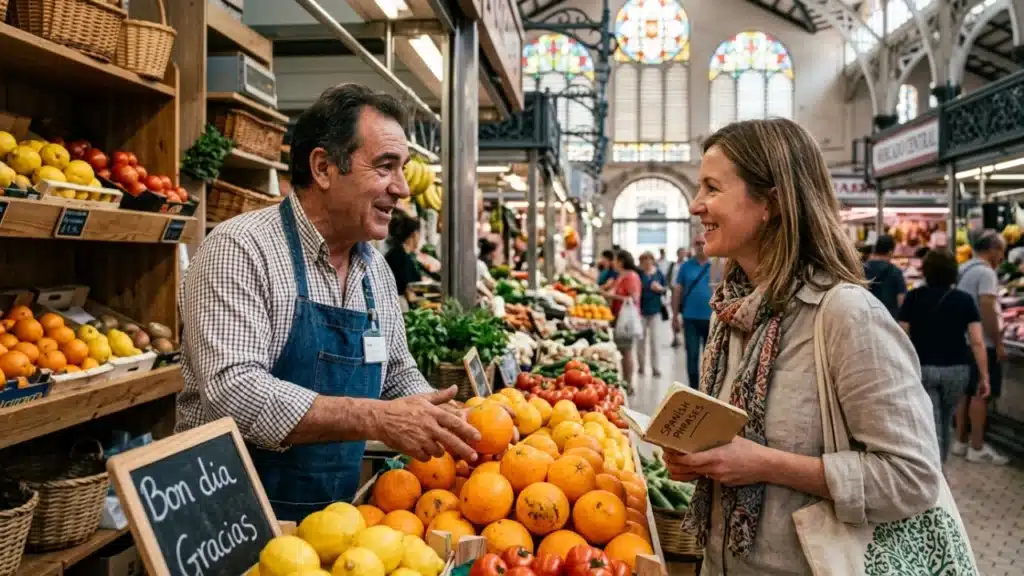
Why Making an Effort with Basic Spanish in Valencia Matters
Valencia mixes futuristic architecture with narrow, ancient streets. Unlike the tourist-heavy hubs of Madrid or Barcelona, where English is widely spoken in almost every service sector, Valencia retains a more authentic, local feel. While you can certainly navigate the main tourist attractions with English, the city really opens up once you start using the everyday Spanish that locals appreciate. Making an effort with the language is more than a practical necessity. It is a sign of respect that opens doors to a richer experience.
In Valencia, locals are incredibly proud of their heritage and their city. When they see an expat or a visitor attempting to order their café con leche or ask for directions in Spanish, the atmosphere shifts. You move from being a “tourist” to being a “neighbour.” The effort bridges the cultural gap and often brings warmer service, extra tips on the best local haunts, and a real sense of belonging. Whether you are living the Valencia expat dream or just visiting, your linguistic attempts will be met with patience and encouragement.
Valencia is also a city of neighbourhoods. The staff in a high-end hotel in Ciutat Vella will speak English, but the vendor at your local frutería in Ruzafa or Benimaclet likely won’t. To truly integrate, handle your admin, and feel at home, the basics are what matter most. They turn the city from a pretty backdrop into a place where you actually take part.
Valencia’s Two Languages: Castellano vs. Valenciano
Before diving into phrases, it is essential to understand that Valencia is a bilingual city. You will encounter two languages: Castellano (Standard Spanish) and Valenciano (a dialect of Catalan). While Castellano is the primary language used for daily communication and by the vast majority of residents, Valenciano holds a deep cultural and official status.
You will see Valenciano on street signs, official government documents, and public transport announcements. For example, the famous “North Station” is labeled Estació del Nord in Valenciano and Estación del Norte in Castellano. Don’t let this confuse you! Almost everyone in the city is perfectly bilingual. If you speak Castellano, everyone will understand you. Still, sprinkling in a few Valenciano words is like a “secret handshake” that shows you’ve truly done your homework on local culture.
When you set out to learn the basics here, put about 90% of your energy into Castellano, since it is what you will use for banking, healthcare, and socialising. The remaining 10% can be reserved for those charming local Valenciano expressions that make the locals smile. Understanding this duality helps you navigate the city’s signs and sounds without feeling overwhelmed.
Essential Survival Phrases Organised by Situation
To help you hit the ground running, we have organised the most useful phrases into categories. Remember, the goal isn’t perfection; it’s communication. Use these pronunciation guides to help you feel more confident.
1. Greetings and Politeness
In Valencia, it is customary to greet everyone when entering a small shop or a lift. A simple “Hola” goes a long way, but varying your greetings based on the time of day is even better.
- Hola (OH-la): Hello
- Buenos días (BWAY-nos DEE-as): Good morning
- Buenas tardes (BWAY-nas TAR-des): Good afternoon/evening
- Buenas noches (BWAY-nas NO-ches): Good night
- Por favor (por fa-VOR): Please
- Gracias (GRA-thyas): Thank you
- De nada (de NA-da): You’re welcome
- ¿Cómo estás? (KOH-mo es-TAS): How are you?
- Mucho gusto (MOO-cho GOOS-to): Nice to meet you
2. Shopping at the Market or Boutique
Valencia is famous for its markets, particularly the Mercado Central. Shopping here is an interactive experience where you need to ask for what you want.
- ¿Cuánto cuesta? (KWAN-to KWES-ta): How much does it cost?
- Quería… (ke-REE-a): I would like… (Polite way to order)
- ¿Tiene…? (TYEH-ne): Do you have…?
- Es muy caro (es mwee KA-ro): It’s very expensive
- ¿Puedo pagar con tarjeta? (PWE-do pa-GAR kon tar-KHE-ta): Can I pay by card?
- Solo estoy mirando (SO-lo es-TOY mi-RAN-do): I’m just looking
3. Dining Out: Restaurants and Cafés
Eating is a social ritual in Valencia. Knowing how to handle a menu and the bill makes a real difference. If you find the city’s pace a bit different than expected, remember that Valencia is a Mediterranean paradise with its own unique rhythms.
- Una mesa para dos, por favor (OO-na ME-sa PA-ra dos): A table for two, please
- La cuenta, por favor (la KWEN-ta por fa-VOR): The bill, please
- ¿Qué recomienda? (ke re-ko-MYEN-da): What do you recommend?
- Soy alérgico/a a… (soy a-LER-khi-ko/ka a): I am allergic to…
- Sin carne/pescado (sin KAR-ne / pes-KA-do): Without meat/fish
- ¡Buen provecho! (bwen pro-VE-cho): Enjoy your meal!
4. Appointments and Admin
Whether you are visiting the doctor or the town hall, these phrases will help you manage your schedule.
- Tengo una cita (TEN-go OO-na THEE-ta): I have an appointment
- Quisiera pedir una cita (ki-SYE-ra pe-DEER OO-na THEE-ta): I would like to make an appointment
- ¿A qué hora? (a ke O-ra): At what time?
- No entiendo (no en-TYEN-do): I don’t understand
- ¿Puede repetir, por favor? (PWE-de re-pe-TEER): Can you repeat, please?
5. Banking and Housing
When you are choosing the best neighbourhoods for professionals in Valencia, you will need to talk about flats and finances.
- Quiero abrir una cuenta (KYE-ro ab-REER OO-na KWEN-ta): I want to open an account
- Busco un piso para alquilar (BOOS-ko oon PEE-so PA-ra al-ki-LAR): I’m looking for a flat to rent
- ¿Cuánto es el alquiler? (KWAN-to es el al-ki-LER): How much is the rent?
- ¿Están incluidos los gastos? (es-TAN in-klwee-dos los GAS-tos): Are bills included?
Valenciano Phrases Worth Knowing (The Local Appreciation Multiplier)
If you want to truly impress a local, drop a few Valenciano words into your conversation. It shows you aren’t just learning Spanish, but you are specifically learning Valencia.
| Valenciano Phrase | Pronunciation | English Meaning |
|---|---|---|
| Bon dia | Bon DEE-a | Good morning |
| Bona vesprada | BO-na ves-PRA-da | Good afternoon |
| Gràcies | GRA-thy-es | Thank you |
| Per favor | per fa-VOR | Please |
| Adeu | a-DEW | Goodbye |
| Che! | CHE | Hey! / Wow! (A general exclamation) |
Che is the most iconic Valencian expression. It’s used to start sentences, express surprise, or even frustration. “Che, ¡qué bueno!” is a classic way to react to a delicious plate of paella.
Cultural Communication Tips: Beyond the Words
Speaking Spanish in Valencia involves more than vocabulary. It means picking up the unwritten rules of how people interact here. Communication is high-energy and physical.
1. Spanish Directness
English speakers often find Spanish very direct. In the UK, we use layers of politeness: “I was wondering if I could possibly have a coffee, please?” In Valencia, this sounds overly complicated and confusing. A simple “Un café, por favor” is perfectly polite. Don’t mistake brevity for rudeness; it’s simply efficiency.
2. Personal Space and Gestures
Expect a smaller “personal bubble.” People stand closer together when talking, and physical touch (a hand on the shoulder or the double cheek kiss for greetings) is common. Gestures are also important. Spaniards speak with their hands, and you should too! It helps convey meaning when your vocabulary fails you.
3. Meal Times and the “Sobremesa”
Understanding the clock is part of the language. Lunch (la comida) is the main meal, usually between 2:00 PM and 4:00 PM. Dinner (la cena) rarely happens before 9:00 PM. One of the most important cultural concepts is the sobremesa, the time spent chatting at the table long after the meal has finished. Never rush away the moment the bill is paid; that’s when the best conversations happen.
4. The Volume Level
Valencia is a loud, lively city. Whether it’s the mascletà firecrackers or just a lively bar, the volume of conversation is higher than in Northern Europe. Don’t be intimidated; the “noise” is usually just a sign of people enjoying life.
Best Resources for Learning Basic Spanish in Valencia
If you are moving to the city and want to learn Spanish in Valencia properly, you have a wealth of resources at your fingertips. Spanish classes, courses, and language exchanges all help, and combining digital tools with real-world practice is the fastest way to progress.
- Language Apps: Duolingo and Wlingua are great for vocabulary, but Babbel or Busuu tend to offer better grammar explanations for European Spanish.
- Language Schools: Valencia has excellent schools like Hispania, AIP Language Institute, and Españolé. These schools offer intensive courses that are great for building a foundation. The Valencia language schools directory lists more options by neighbourhood.
- Intercambios (Language Exchanges): These are the most fun way to learn. Bars like Big Ben in Plaza Honduras or various cafes in Ruzafa host weekly exchange nights. You spend 30 minutes speaking English with a local and 30 minutes speaking Spanish.
- Immersion Tips: Change your phone’s language to Spanish. Watch Spanish Netflix shows with Spanish subtitles. Listen to local radio stations like Radio Valencia (Cadena SER) to get used to the accent.
Pro Tip: Many relocation services now offer “Settling-in Packages” that include a few weeks of private Spanish lessons and cultural orientation. It can be a game-changer for professionals who need to get up to speed quickly without the stress of self-study.
How Long to Basic Fluency? Realistic Timelines
One of the most common questions is: “How long until I can speak Spanish that locals actually understand?” Everyone learns at a different pace, but here is a rough guide for English speakers:
- 1 to 4 Weeks (The Survival Stage): You can order food, greet people, and handle very basic transactions. You will still rely heavily on gestures and Google Translate.
- 3 Months (The Functional Stage): With consistent study (3-5 hours a week), you can have simple conversations about your life, work, and hobbies. You can handle most administrative tasks with a bit of patience.
- 6 to 12 Months (The Conversational Stage): You can follow group conversations (though maybe not every joke) and express your opinions. You feel comfortable in most social situations.
The key to accelerating this timeline is consistency over intensity. Fifteen minutes of practice every single day is far more effective than a three-hour cram session once a week.
Common Mistakes English Speakers Make and How to Avoid Them
Don’t be afraid of mistakes. They are the stepping stones to fluency. Being aware of a few common pitfalls, though, can save you some awkward moments.
1. The “False Friends” (Falsos Amigos)
Some words look like English words but mean something entirely different.
- Embarazada: Does NOT mean embarrassed. It means pregnant. (Use avergonzado for embarrassed).
- Constipado: Does NOT mean constipated. It means you have a cold. (Use estreñido for the other one).
- Librería: Does NOT mean library. It means bookshop. (A library is a biblioteca).
2. Overusing “Yo”
In English, we always use the pronoun (I am, you are). In Spanish, the verb ending tells you who is doing the action. Saying “Yo quiero” instead of just “Quiero” makes you sound a bit like a robot. Drop the “Yo” once you feel comfortable!
3. Mixing up Ser and Estar
Spanish has two verbs for “to be.” Ser is for permanent traits (nationality, personality), and Estar is for temporary states (location, mood). “Soy cansado” means you are a tiresome person by nature. “Estoy cansado” means you are tired right now. It’s a small difference that changes the whole meaning!
4. Fear of the “R”
Many English speakers are shy about the rolled ‘R’. Don’t be! Even if you can’t roll it perfectly, making the effort to pronounce it clearly helps locals understand you better. Practise saying “perro” (dog) vs “pero” (but).
Conclusion: Embrace the Journey
Learning the basics of Spanish in Valencia is an investment that pays off in friendships, convenience, and a deeper feel for the place. The people of Valencia are famously welcoming to those who show an interest in their way of life. By mastering a few key phrases, understanding the local linguistic blend, and respecting the cultural rhythms of the city, you will find that your transition to life in Spain becomes infinitely smoother.
Remember, the goal isn’t to speak like a native overnight. The goal is to connect. Every time you use a Spanish phrase instead of an English one, you are building a bridge. So, head down to the local cafetería, order that zumo de naranja (Valencia has the best oranges in the world, after all), and start a conversation. You’ve got this!
Frequently Asked Questions
Is it possible to live in Valencia only speaking English?
Technically yes, especially in the city centre or expat enclaves, but your life will be much harder. Admin, healthcare, and building real friendships with locals all get tougher. Learning even a little Spanish will make a real difference to your quality of life.
Do I need to learn Valenciano to live there?
No, you do not need to be fluent in Valenciano. Everyone speaks Castellano (Spanish), and learning a few greetings and reading signs in Valenciano is appreciated by locals and helps you find your way around.
What is the best way to find a language exchange in Valencia?
The best way is to use apps like Meetup.com or search for “Intercambio de idiomas Valencia” on Facebook. There are events almost every night of the week in neighbourhoods like Ruzafa, El Carmen, and near the universities.
Are people in Valencia patient with Spanish learners?
Generally, yes! Valencians are very proud of their city and usually delighted when foreigners try to speak their language. They are much more likely to help you find the right word than to be annoyed by your mistakes.
Should I take classes before I move or wait until I arrive?
Doing some basic preparation (like using an app or taking online lessons) before you arrive is highly recommended. It reduces the initial stress of arrival. Once you are on the ground, joining a local school or hiring a tutor will help you apply what you’ve learned in real-world contexts.