Website localization services that make a site sell in its market
From the copy to the checkout: currency, payment methods, shipping rules and a layout that survives a third more text
We adapt the prices, form fields, trust marks and search habits of each market, so a translated site reads as local and wins the enquiry.
Mike is very driven and extremely professional in every aspect of his work. He takes a great deal of care with each task and always puts his client first, ensuring their needs are met during each… stage of the process. Mike's professionalism and vast experience makes him a reliable choice and one you can count on time and time again.View on Google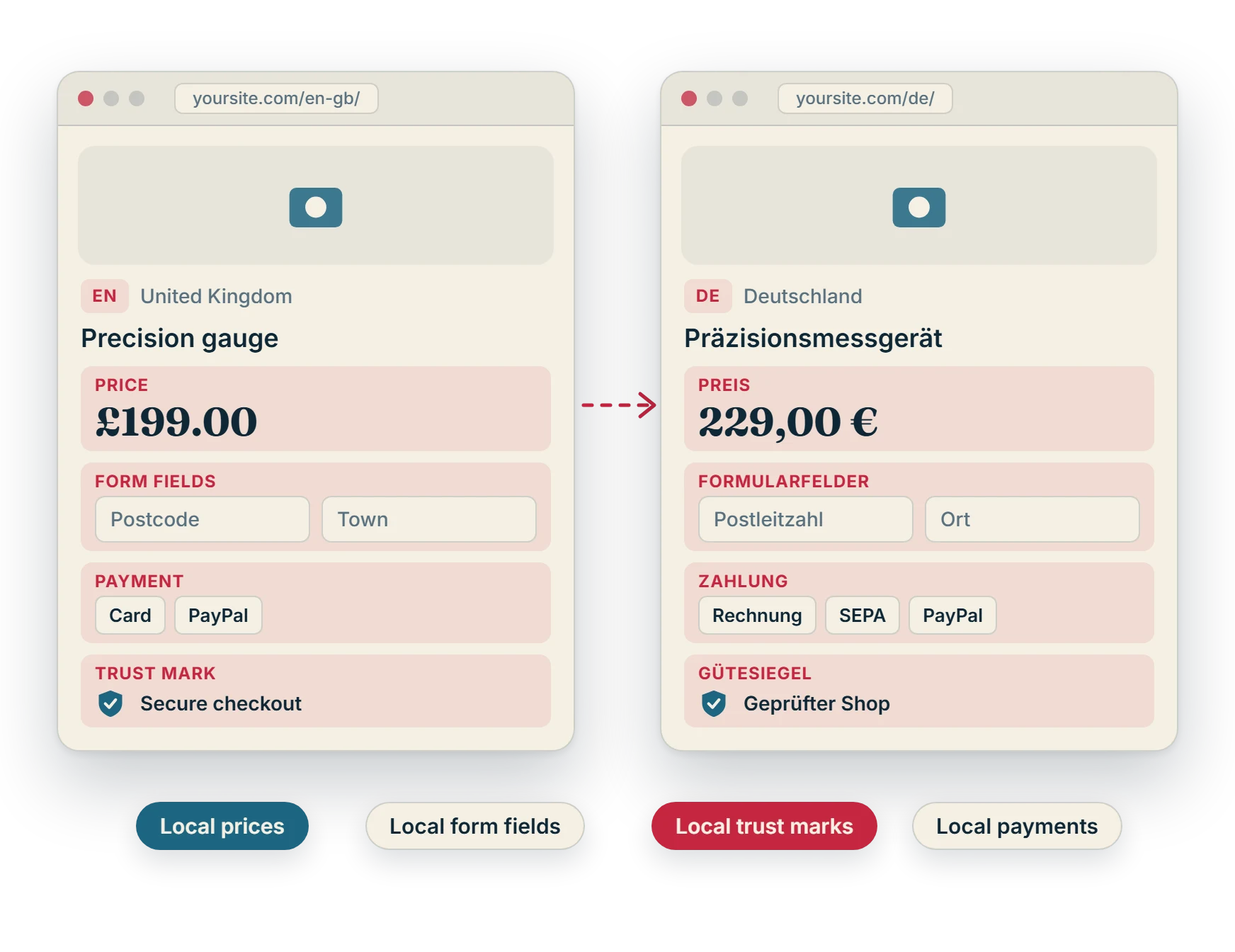
What you get from a website localization project
Copy that reads as local. We localize the page text, the calls to action, dates, imagery and trust marks for each market, so every language version reads as written for the people buying in it.
A checkout each market recognises. On WooCommerce, Shopify and Magento we set local currency, prices formatted the way each market writes them, local payment methods and checkout flows per region, since shoppers are more likely to complete when they see a payment option they know.
Layouts with room for every language. We adjust buttons, menus, headings and price tables for the text expansion German routinely needs against an English source, mirror the layout for right-to-left languages such as Arabic, and set correct character encoding across every language in scope.
A localization test pass before launch. We check every page, form, menu and language switcher in each language for display, function and fit, and put every issue in one report, where it is quickest to fix.
The multilingual setup we build underneath the words
We choose and set up the multilingual plugin that fits your site and your team. WPML is our default for WordPress, Polylang suits tighter budgets or simpler structures, and TranslatePress fits a non-technical content team that translates in context on the front end. We also work with Weglot, Shopify and Webflow.
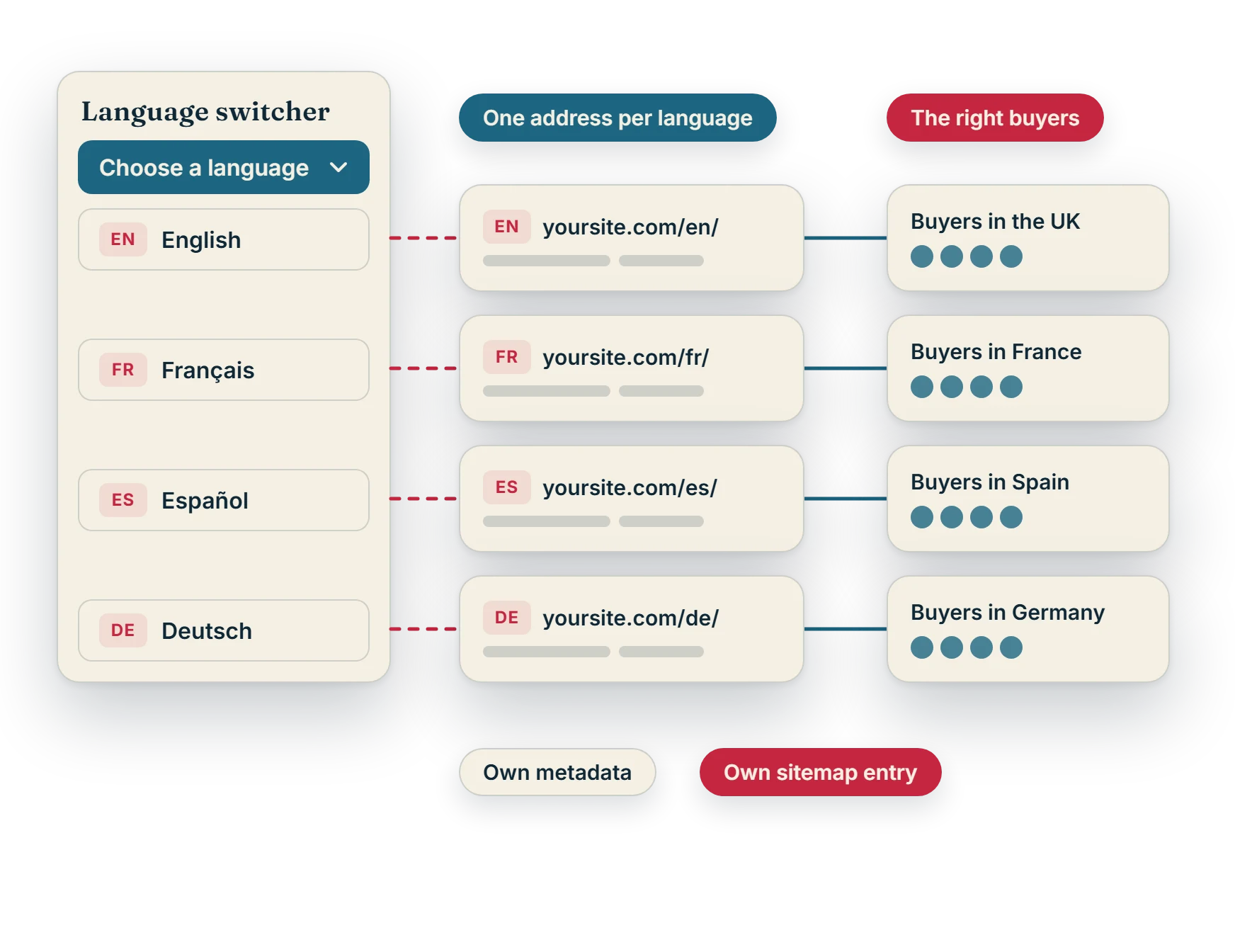
We build on WordPress, Joomla, Drupal or a custom platform, so each language version launches with its own URL, its own metadata and its own place in the sitemap, ready to rank in its market.
A four-language property site that stays correct as listings turn over weekly
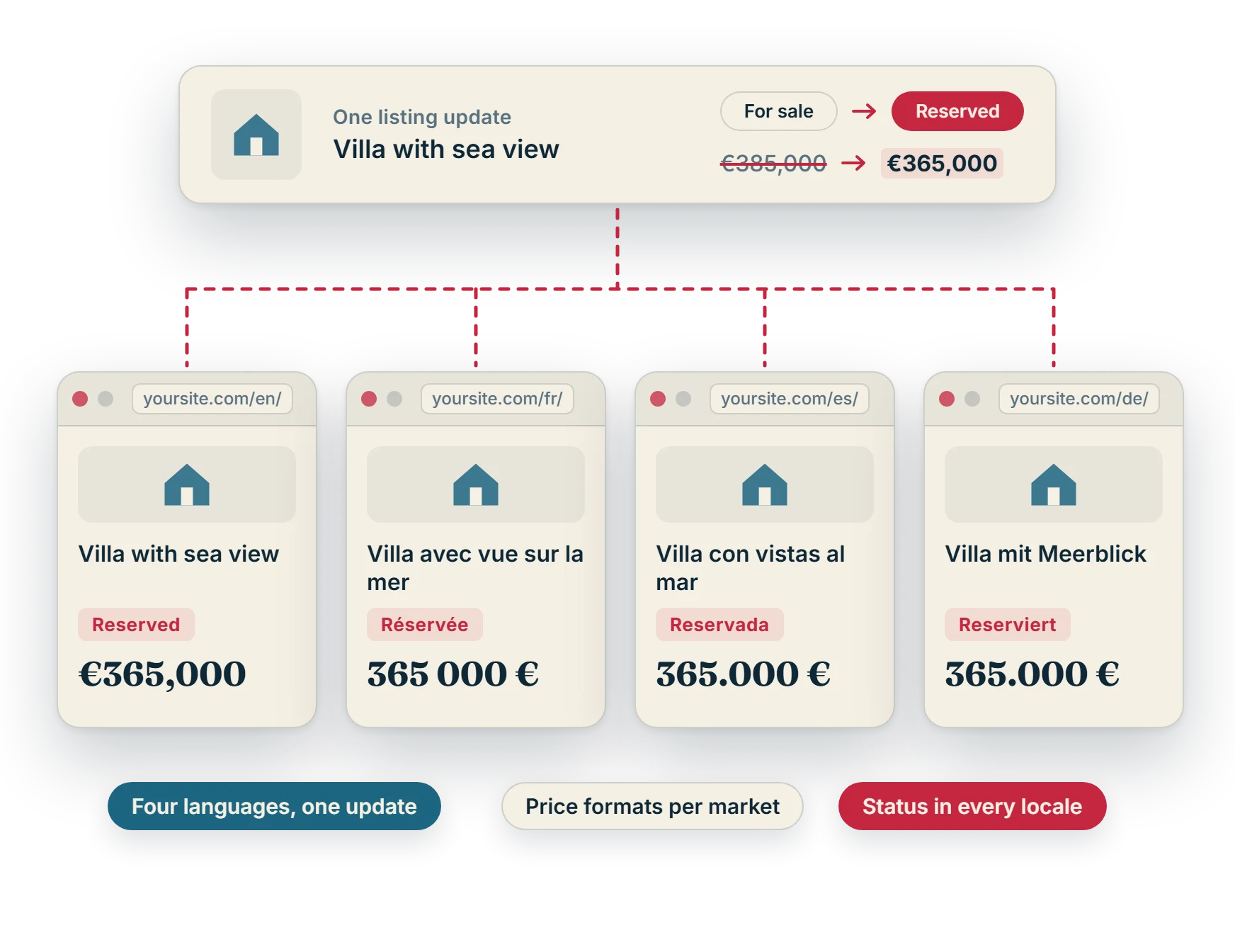
Century 21 Perdomo sells Dominican real estate in four languages on a headless WordPress, WPML and WooCommerce stack, where a property selling, a price moving or a status flipping has to update correctly in all four locales at once.
Open what you need
What we localize and set up beyond the copy
Plugin choice, layout, checkout, testing and platforms beyond WordPress, each handled inside the same project.
Multilingual plugin choice and setup
We pick the plugin from how your site is built and who will run it, then set it up. WPML is the most complete on SEO, asks the most of your hosting and carries a licence to renew. Polylang fits a tighter budget and a simpler structure, and suits straightforward translation workflows. TranslatePress suits a non-technical team that translates on the front end, seeing the page as they change it. MultilingualPress suits a multisite network. GTranslate offers machine translation with a switcher, which is a different product from a localized site.
We settle the choice at the start, because the content ends up stored the plugin's way, and the right plugin keeps every language easy to maintain for years.
Layouts built for text expansion
We size buttons, menu items and headings for German compounds and French expansion, and test the layout with real localized copy at the places that matter most: the navigation, the call to action and the price table.
For right-to-left languages we mirror the whole layout, and we check character encoding on forms, search and anything that touches a database, so every script displays as it should.
Checkout localization for online stores
Product descriptions and SKUs are the visible half. We also localize the half that moves the conversion rate: the currency shown, prices formatted the way each market writes them, the payment methods offered and an address form shaped the local way.
WooCommerce, Shopify and Magento each expose these settings differently, so we set them up per platform until the last step of the checkout feels as local as the first.
Localization testing before launch
We test every interface element, form, menu, switcher and piece of multimedia in each language for display, function and fit: the language switcher landing on the right page, a form accepting every valid local postcode, a date with the day and month in the local order.
The pass also covers what the market requires legally, from consent handling to accessibility, and you get every issue in one report before launch.
Localization on Joomla, Drupal and custom builds
Joomla and Drupal both handle multilingual content well, each in its own way, and we agree the content model with you before anything gets translated.
On every platform we give each language version its own URL, its own metadata and its own place in the sitemap, so a search engine can rank it per market.
From the brief to the reporting
What happens after your first message
- A free localization assessmentWe review your site in each language you sell in and show you where the copy, prices, checkout and layout most need adapting for each market.
- A written scopeAfter the first call you get a written scope naming the pages, the markets and the deliverables, so you know exactly what we localize and set up.
- Plugin choice and setupWe choose the multilingual plugin that fits your site and your team, from WPML, Polylang, TranslatePress or Weglot, or work in Shopify or Webflow, and set it up per language.
- Copy, prices and checkout localizedWe adapt the copy, currency, payment methods and checkout for each market, and adjust the layout so longer text sits cleanly in buttons, menus and headings.
- A localization test pass before launchWe test every language for display, function and fit, put every issue in one report and fix each one before your localized site goes live.

Who does the work
Mike Bastin and his team, working from Valencia in your buyers’ languages
Mike has worked in multilingual search for over two decades and founded BeTranslated, the translation agency he has run for twenty years, whose ten country sites each compete in their own market. He works natively in French, fluently in English, Spanish and Dutch, and well enough in German, Italian and Portuguese to run SEO projects in them.
We run our own sites the way we run yours. See how we built ValenciaMove, our relocation site for Valencia in five languages.
Mike leads the team on every engagement, so you deal with him from the first call to the monthly report.
The next step
Find out what website localization could be worth in your markets
A free localization assessment of your site in each language you sell in, then a written scope naming the pages, markets and deliverables. The project ends at launch.
The whole scope
What else we take on for you
Localization is one job with six places to get right, and the copy is only the first of them. Content first: pages that read as though written for the market.
Then the machinery. A CMS wired so editors can publish in every language on their own, WordPress plugins such as WPML, Weglot and Polylang set up properly, since they decide a site's URLs and hreflang whether or not anyone configured them, and a store where currency, payment methods, shipping rules and product data all change per market.
And the interface has to hold. German runs about a third longer than the English a layout was designed around, so we test the built thing before launch: text that fits its box, dates and currencies in the local format, and every string in the menu translated.
Also in localization