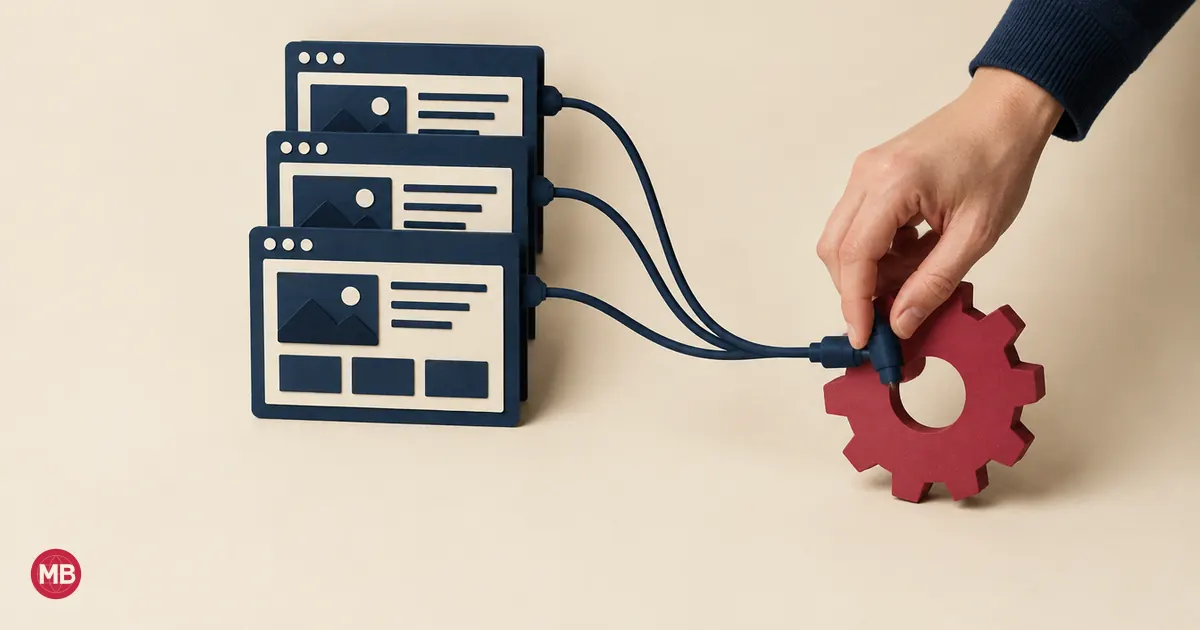
From a translated brand to a global brand strategy
You launched in Spain, France and the Netherlands with the same brand, carefully translated. Six months later your in-market teams are rewriting the copy so it sounds right to local buyers, and the localized sites have room to catch up with the English one.
Most “global brand” projects we see start as translation projects. The step from “translated” to “genuinely global” is where building a global brand actually lives, and where your other markets gain revenue.
Below: which parts of your brand travel as they are, which need work in each market, and a checklist to run before your next launch.
What changes between markets, even when the brand stays the same
Small shifts in emphasis decide whether a buyer keeps reading. We see it on our own sites: we run BeTranslated across ten country domains, .com, .us, .ca, .co.uk, .be, .fr, .es, .de, .nl and .it, same agency, same service, same positioning at the strategic level. The execution differs in ways that matter to conversion.
- Belgian B2B audiences want functional precision and pricing clarity early. Put the facts in the first paragraph.
- French B2B audiences expect a more formal register and more context before any commercial ask. Vouvoyer is non-negotiable.
- Spanish buyers respond to relationship signals. Author bio, photos, phone number prominently shown. A face on the funnel converts.
- Dutch buyers want directness and concrete numbers. Pricing transparency converts harder than feature lists.
- UK B2B audiences sit between formal and direct. Wit lands well, with a light touch on the sell.
Same brand, five different on-page emphases. Every one of these adjustments keeps the identity intact and makes it land.
What travels and what needs work
Knowing which is which tells you where to spend the localization budget and where to save it.
| Brand element | Travels as is? | What to do per market |
|---|---|---|
| Visual identity | Yes | Keep it as is, if the system was disciplined |
| Strategic positioning | Yes | Translate the one-liner, keep the meaning |
| Proof points and metrics | Yes | Add local proof where you have it |
| Tone of voice | No | Transcreate, budget for it |
| Cultural references and humour | No | Replace with a local equivalent |
| Trust signals | No | Local reviews, phone, address, payment methods |

Three things that travel as they are
These are where you save money. In our experience they cross markets as they are.
Visual identity. Logo, palette, typography, photographic style. These move clean across borders if the original system was disciplined.
Strategic positioning. The one-line answer to “what do you do and for whom” is usually translatable verbatim. What you sell reads the same in every market.
Proof points and metrics. Numbers, case studies, awards. Specifics carry credibility everywhere.
Three things that need market-by-market work
These decide whether the brand lands, so the budget goes here.
Tone of voice. Directness that suits Dutch needs softening for French. Warmth that suits Spanish needs toning down for German. Voice is the most expensive part of multilingual brand work, and the part most worth budgeting for properly.
66% of business users said they would pay up to 30% more for a localized product, in CSA Research's survey of 1,116 B2B buyers of technology products.
Cultural references and humour. A British-flavoured tagline needs a Spanish equivalent for Madrid, and French wordplay needs a Flemish one for Antwerp. Brief a writer in each market on the brand, and each version keeps its spark.
Trust signals. Reviews from local clients, local phone numbers, local addresses, payment methods buyers recognise. Cultural differences in multilingual websites show up most sharply in this layer.
73% of consumers want product reviews in their own language, if nothing else, according to a 2020 survey in 29 countries.
Source: CSA Research, "Can't Read, Won't Buy", survey of 8,709 consumers in 29 countries, 7 July 2020
A pattern we keep seeing in global launches
The pattern goes like this. A brand decides to “go global”, marketing commissions a translation agency, and six locales launch simultaneously. The English version keeps converting; the localized versions convert at a fraction of its rate.
A few weeks later someone calls us and asks why “the SEO is not working”.
The SEO is fine. What the brand needs is to land: translation moved the words, and the brand has to move with them.
Fixing it takes a transcreation pass plus on-page tweaks per market, the core of website localization. Eight to twelve weeks for the full set, depending on language count.
Answer these before you launch in a new market
Every item below is cheaper to fix before launch than after. Answer these before you ship.
- Has the headline been transcreated for the market?
- Does the local site list a local phone number, address, and named contact?
- Do testimonials come from clients in that market, in that language?
- Have payment methods, currencies, and tax inclusion rules been adapted?
- Does the meta title use the search term local buyers actually type?
- Have you checked the page on a Spanish, French, German keyboard layout?
Tick all six and the brand has arrived, as well as crossed the border.
A second pair of eyes on your global brand work
If you are launching across two or more markets, we are happy to look at the gap between your strategic brand and what each market actually sees.
We work in French, English, Spanish, and Dutch fluently, and know enough German and Italian to manage SEO projects in both. Most of what we do for clients sits on the seam between brand voice and SEO performance, where getting it right earns real revenue.
Book a discovery call or read more about how we run multilingual branding work.